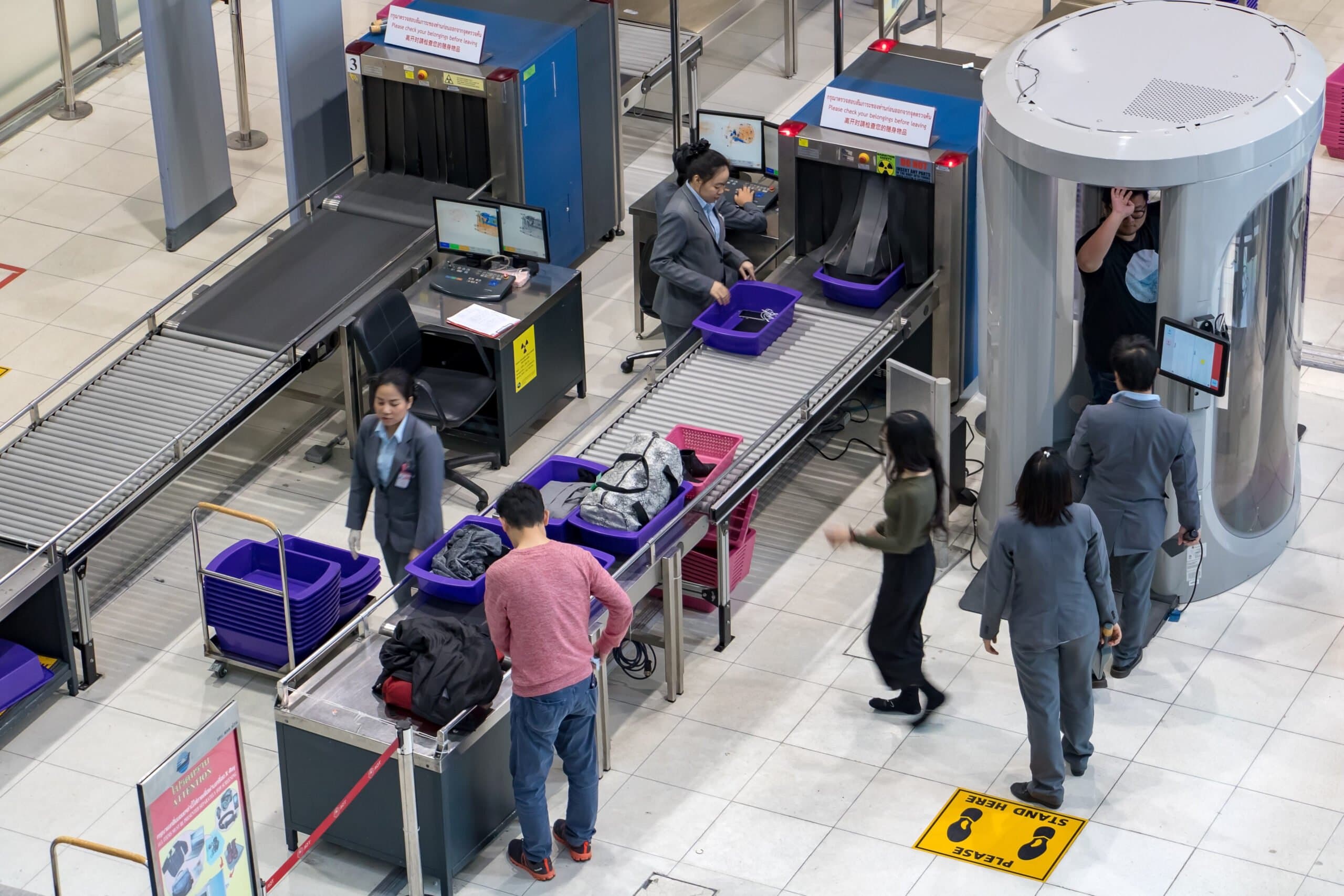
For me, as someone who drinks a lot of water, I think the most unpleasant part is having to throw away water that I have just taken a sip or two from. But have you ever wondered why all this is done? Today, I want to explain why these procedures carried out at the airport are very important and necessary, by mentioning a few incidents that have gone down in aviation history.
Passenger Bag Match
On December 21, 1988, on Pan Am Flight 103 from London to New York, 38 minutes after takeoff, a plastic explosive placed in a radio device inside the luggage by a terrorist exploded over the town of Lockerbie, Scotland, killing 259 people on board and 11 people on the ground. Work was carried out for many years to investigate the cause of the explosion, and as a result, statements were taken from 15,000 people from 20 countries, and 35,000 photographs and 180,000 pieces of evidence were examined. The investigation in question was also recorded as the largest murder investigation in British history. Because 189 of the victims were American citizens, it is also considered the largest terrorist attack targeting American citizens before September 11. Among a series of measures taken after this tragic explosion, which caused the loss of many lives, was the sensitivity regarding the passenger-bag match. As those who remember the Lockerbie tragedy will recall, the terrorist who carried out the attack had put his bag containing the time bomb on the plane, but he himself had not boarded the plane.
Following the disaster, important developments also occurred in terms of international relations. The U.S. and the U.K. claimed that the two Libyan citizens who carried out the terrorist act were acting on behalf of the state, and this explosion became the subject of the United Nations Security Council. Pursuant to the Security Council’s resolution no. 728/1992 dated March 31, 1992, a call was made to implement economic and political sanctions if the two perpetrators of the attack were not sent to the U.K. or the U.S. for trial, and economic, political, and technical sanctions against Libya began to be implemented on April 15, 1992. Libya, however, argued that it was conducting criminal prosecution; that it was obligated to try these two defendants in its own courts, and that it could not be forced to extradite its own citizens. As a result of the long process, on August 15, 2003, Libya submitted a letter to the U.N. Security Council, accepting the responsibility of the Libyan authorities for the explosion on Pan Am Flight 103, and agreed to pay $10 million U.S. Dollars to each family, conditional on the lifting of the sanctions imposed on it.
Restrictions on Liquids
Despite all the measures taken regarding aviation security after the September 11 attacks, terrorists tried to achieve their goals by trying other methods. One of these attempts occurred in 2006. So, what does this have to do with liquid restrictions?
The suspects were monitored for a long time after it was suspected that members of the Al-Qaeda terrorist organization in Pakistan and members of the organization living in the U.K. would carry out a joint terrorist act. During the monitoring, their research and purchases regarding hydrogen peroxide and beverage bottles attracted attention.
As a result of the long-term monitoring operation, it was understood that the individuals in question planned to carry out the terrorist act with liquid hydrogen peroxide and batteries that they planned to sneak onto the plane in beverage bottles. It was determined that the terrorists’ target was to simultaneously blow up 7 transatlantic flights. Fortunately, the attack was prevented thanks to a joint operation carried out by the U.K., the U.S., and Pakistan two weeks before it was to be implemented, but if it had not been prevented, a major disaster would have occurred.
In connection with this incident, 12 people were convicted, 8 of whom were directly related to making liquid explosives, and it became clear that new measures regarding liquids were necessary for aviation.
Shoe Removal
Although a major disaster was prevented as a result of meticulous work in the incident I just mentioned, unfortunately, this is not always possible. An example of this occurred shortly after the September 11 attacks, and in the attack on December 22, 2001, the disaster was prevented entirely by chance.
This time, the person who wanted to carry out the terrorist act, named Richard Reid, hid a homemade explosive inside his shoe, and the crime remained at the attempted stage because he had trouble igniting the fuse while trying to detonate it during the flight. The plane subsequently landed at Logan International Airport in Boston. In 2002, Reid, the perpetrator of the incident, was sentenced to life imprisonment for eight terror-related crimes.
A similar incident was attempted this time with a device set up on underwear. The 23-year-old terrorist, who was originally an engineer, set off from the Netherlands on Christmas 2009 on Flight 253 towards Detroit Metropolitan Airport. The terrorist, who attempted to detonate the bomb while the plane was about to land at the airport, fortunately did not achieve his goal. The fire that broke out in the plane due to this attempt was quickly extinguished with the intervention of passengers and crew, and the terrorist in question was neutralized.
Unfortunately, it is possible to multiply these unpleasant examples.
Every incident that has occurred has led to new lessons being learned and sometimes entirely new measures being taken. However, sometimes these measures themselves have been the cause of the disaster. In 2015, everyone on board the Germanwings flight died when the co-pilot intentionally crashed the plane while alone in the cockpit, and the other pilot who was outside could not access the cockpit at all. Why? Because after the September 11 attacks, external access to the cockpit was made impossible for security reasons, and therefore nothing could be done during the co-pilot’s suicide flight, and many people lost their lives.
This is why security measures are so sensitive and critically important.
I wish you all healthy, safe, and secure days,
With my respect and love,