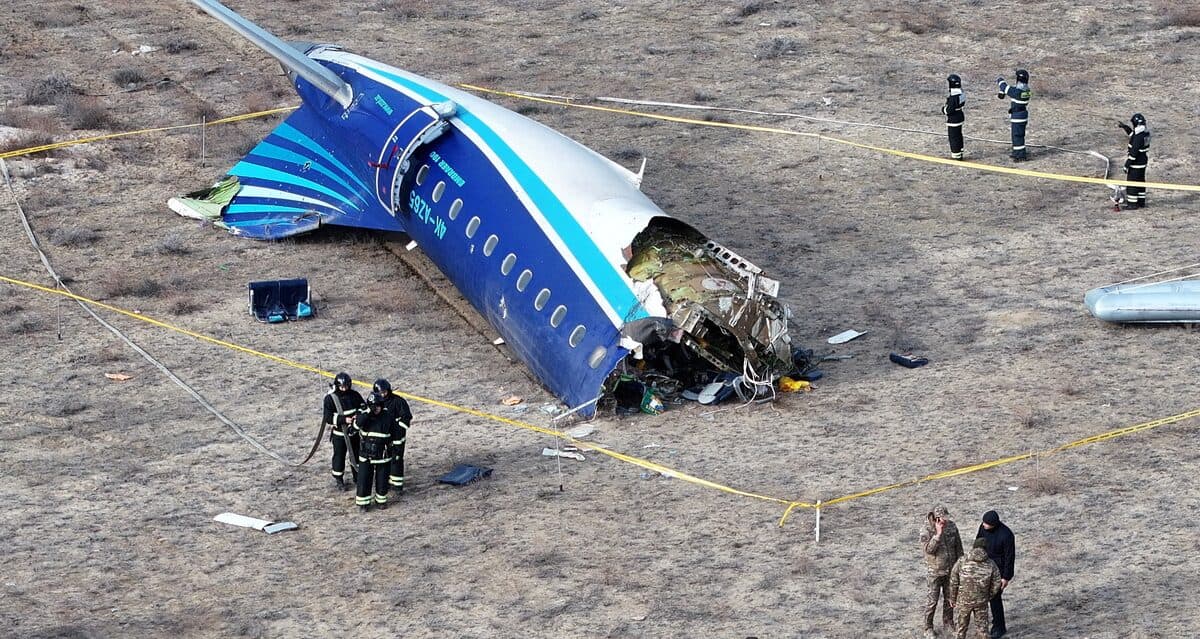

This tragic event brought to my mind previous attacks on civilian aircraft. Therefore, in today's article, I want to briefly talk about some other examples where countries have shot down aircraft that entered their airspace.
The first attack on a commercial airline's aircraft occurred in 1938 against a plane of the China National Aviation Corporation. After departing from Hong Kong's Kai Tak Airport for Chongqing, the Douglas DC-2 aircraft, known as 'Kweilin', was heavily damaged by a Japanese attack on August 24, 1938. The aircraft managed to land on a river, after which it was continuously fired upon by the Japanese for over an hour, and 14 of the 17 people on board lost their lives. The American pilot of the plane survived the attack. After this attack, the aircraft was repaired and returned to service, but this time it was attacked by the Japanese after landing at Changyi Airport, and as a result of this attack, 9 of the 12 people on board died. The aircraft, which was attacked for the second time in 1940, did not fly again.
When the calendars showed July 23, 1954, this time the target was a Cathay Pacific Airways aircraft. The plane, carrying 12 passengers and 6 crew members on a flight from Singapore to Bangkok, was shot down by a Chinese Lachovlin La-7 fighter jet. The survivors were rescued by the US Air Force. China, which carried out the attack that killed 10 of the 18 people on board, later apologized, stating they had mistaken it for a warplane. Many conspiracy theories were produced as to why the plane was shot down.
Not long after this tragic accident, a similar event occurred, this time in Bulgaria. The aircraft, flying from London to Tel Aviv, took off from Heathrow Airport on July 26, 1955, to go to today's Ben Gurion International Airport, following stops in Vienna and Istanbul. The aircraft, which took off around 03:00 to go to Istanbul after the stopover in Vienna, was caught in a storm shortly after. With the malfunction of the navigation system (NDR) due to the storm, the pilot accidentally entered Bulgarian airspace. The Bulgarian air force, noticing the airspace violation, subsequently shot down the aircraft on July 27, 1955, as it approached the country's southern border and was about to enter Greek airspace. All 51 passengers and 7 crew members on board lost their lives. Following international pressure, Bulgaria, which was then in the Soviet Bloc, paid $200,000 USD to Israel.
On February 21, 1973, a Libyan Arab Airlines Boeing 727-200 aircraft took off from Tripoli for a scheduled flight to Cairo with a stop in Benghazi. The pilot, who got lost in northern Egypt due to a malfunction in the aircraft and bad weather conditions, entered the Israeli-controlled Sinai Peninsula. According to Israel's claim, the aircraft, which flew over Israeli military installations above the Suez Canal, was shot down by Israel over the Sinai Desert. In this tragic incident where only 5 of the 113 passengers survived, Israel claimed it shot down the aircraft to thwart a potential terrorist attack.
On April 20, 1978, a Korean Air Lines aircraft, flying from Paris to Seoul, deviated from its route due to a navigational device malfunction according to the co-pilot's statement, and entered Soviet airspace. The plane was attacked and forced to land on a frozen river about 300 miles south of Murmansk. As a result of the Soviet's armed attack, two people lost their lives, and many others were injured in this incident.
On June 27, 1980, an Itavia Airlines DC-9 aircraft, which took off from Bologna with 77 passengers and 4 crew members, disappeared from the radar screen about an hour after takeoff. The last message received was the pilot reporting that he was beginning his descent. Just a few hours after the pilot's last words, the wreckage of the plane was found in the Tyrrhenian Sea, off the coast of Ustica Island near Sicily. Two years after this disaster, the question of why Italian citizens did not have the same information about the accident as British and American experts was raised in the Italian Parliament. In the report prepared by the Terrorism Commission of the Italian Parliament in 1989, it was claimed that the aircraft was shot down by the military, and this accident was referred to as the "Ustica Massacre." As a result of long-lasting investigations and trials, the Italian Court of Cassation ruled on January 28, 2013, that the accident was caused by the aircraft being shot down as part of a warlike scenario and decided that the state should pay compensation to the families of the victims for failing to ensure the safety of the passengers.
In all these civilian aircraft incidents I have described above, unfortunately, many people lost their lives. However, the incident that prompted aviation authorities to establish regulations against attacking civilian aircraft was the attack on the Korean Air Lines plane. The Korean Air Lines Boeing 747-203B aircraft, with 23 crew members and 246 passengers, began its journey from Anchorage Airport in Alaska to Seoul Airport. Shortly after takeoff, the pilots set the autopilot but unknowingly deviated from the route and, about an hour later, entered an airspace over the Soviet Union that was used for missile tests and was closely monitored. The aircraft crossed the Kamchatka Peninsula and continued to the Sea of Okhotsk. The aircraft, which then entered international airspace, re-entered Russian Airspace and was shot down by air-to-air missiles on September 1, 1983, just as it was about to leave the airspace again.
The assembly of the International Civil Aviation Organization (ICAO), in its extraordinary session held in Montreal on May 10, 1984, following the attack that claimed 269 lives, evaluated the need to balance national sovereignty and security concerns with safety. In accordance with Article 94(a) of the Chicago Convention concerning the amendment of the Convention, it was agreed to add a new article (Article 3bis) regarding the non-use of weapons against civilian aircraft. According to this article, States shall refrain from resorting to the use of weapons against civil aircraft in flight, and if they must intercept, they shall refrain from endangering the lives of persons on board and the safety of the aircraft. In return, this provision shall not be interpreted as modifying in any way the rights and obligations of States under the Charter of the United Nations.
I will continue to evaluate what this regulation means and what other attacks have occurred in aviation history in my next article.