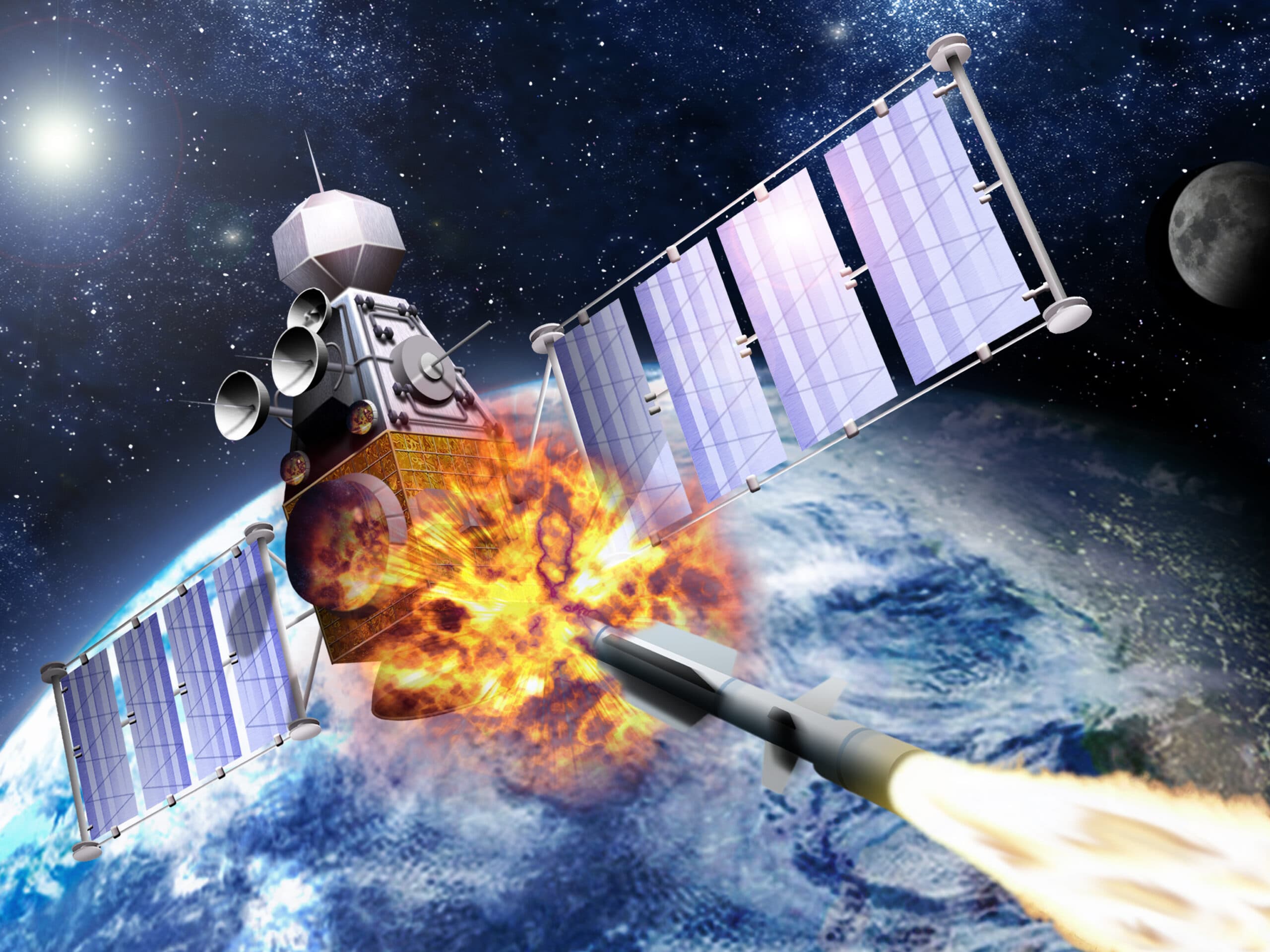

At the point we have reached today, the issue of military use of space has become even more important. I left off in my last article on the subject of ballistic missiles. What does space law say about the use of ballistic missiles?
As you will remember, under Article 4 of the Outer Space Treaty, placing weapons of mass destruction or nuclear weapons in orbit or installing them on celestial bodies is prohibited. It is argued by some jurists, based on the letter of the article, that the use of space for the transit of such weapons would not violate the article. Therefore, according to a group of jurists with whom I agree, it is possible to conclude that ballistic missiles are also not banned under Article 4. Although we cannot say that ballistic missiles are banned under the article, we can say that there have been some other initiatives towards this aim. For example, The Hague Code of Conduct Against Ballistic Missile Proliferation (HCoC), which has political force, was established with the aim of creating a political framework to prevent the proliferation of ballistic missiles, ensuring confidence and transparency by providing pre-launch notification and reporting, and strengthening existing systems. The rules adopted after a conference held in The Hague on November 25, 2002, support the Missile Technology Control Regime (MTCR). (Speaking of ballistic missiles, of course, perhaps the first things that come to mind are some talks and treaties between the USSR and the USA; however, since I am covering the general topic of military activities and armament in space in this article series, I prefer to discuss the process between the USA and the USSR in another article.).
On December 3, 2004, the United Nations General Assembly adopted resolution A/Res/59/91, inviting non-party countries to become parties to the HCoC. Similar resolutions were adopted in the following years. Among the issues regulated under these rules are that member states will refrain as much as possible from the testing and development of ballistic missiles for global and regional peace and security; they will annually declare their ballistic missile policies, provide information on the number and category of ballistic missiles launched in the previous year, and become parties to the Outer Space Treaty (1967), the Liability Convention (1972), and the Registration Convention (1975). The number of signatory countries to these rules of conduct, which Turkey also adopted on November 25, 2002, rose to 143 with Austria’s signature in 2002.
Another important initiative regarding military activities and armament in space is the “Conference on Disarmament.” As a result of the special session of the United Nations General Assembly on disarmament in 1978, the “Conference on Disarmament,” where multinational disarmament negotiations are held, was established in 1979. Turkey has also been an active member since 1996. The conference’s agenda includes nuclear disarmament, a treaty banning fissile materials, negative security assurances, and the prevention of an arms race in outer space (PAROS). At the 10th special session on disarmament, it was stated that further measures should be taken in the spirit of the 1967 Treaty to prevent an arms race in outer space. Consequently, two resolutions were adopted in the General Assembly in 1981: the first was a proposal, supported especially by Western European countries, to make an effective agreement concerning the prohibition of anti-satellite systems, and the second was a proposal, supported by Eastern European countries, to make a treaty on the prohibition of placing any weapon in outer space. In 1985, a resolution was adopted to establish an ad hoc committee for PAROS, and the said committee was established and adopted a three-stage program. These are; evaluating issues related to the prevention of an arms race in outer space, evaluating existing agreements on this subject, and evaluating future proposals that could be made.
In 2002, China and Russia jointly submitted a working paper titled “Possible Elements for a Future International Legal Agreement on the Prevention of the Deployment of Weapons in Outer Space, the Threat or Use of Force Against Outer Space Objects.” Again, in 2008, China and Russia proposed the Draft Treaty on the Prevention of the Placement of Weapons in Outer Space. This 14-article draft proposed a ban on the placement of all types of weapons. The USA, however, evaluated this draft as a diplomatic tactic by the two states to gain military advantage and rejected it. Similarly, Canada also submitted working papers in 2007 and 2009. Canada’s working paper also included the possibility of a satellite being a weapon in itself. Around this time, the European Parliament also adopted a resolution on Space and Security and even created a Draft Code of Conduct for Outer Space Activities for the Conference on Disarmament on February 12, 2009. In 2014, China and Russia submitted a second draft, taking into account the criticisms of the first draft, and some amendments were made, such as the definition of outer space and the modification of self-defense provisions.
In 2016, Russia and Venezuela issued a joint statement announcing they would not be the first to place weapons in space (other countries also have statements to this effect). In 2020, the First Committee of the United Nations General Assembly voted to adopt five resolutions on space security. These are resolutions concerning “prevention of an arms race in outer space,” “further practical measures for the prevention of an arms race in outer space,” “no first placement of weapons in outer space,” “transparency and confidence-building measures in outer space activities,” and “reducing space threats through norms, rules and principles of responsible behaviours.” The USA voted against four of these resolutions. On December 7, 2020, the United Nations General Assembly adopted resolutions 75/25, 75/36, 75/37, and 75/69 from the First Committee reports.
In his speech at Rice University on September 12, 1962, then-US President John F. Kennedy stated that since space sciences, just like nuclear sciences and other technologies, have no conscience of their own, the use of space for good or ill would be determined by people, and the USA must have a superior position to help decide whether this will be a sea of peace or a new terrifying theater of war. Nearly sixty years have passed since that speech, and the USA is still one of the important actors in space. But of course, the space policies and military activities of other countries are also important. As you will recall, recently, from March 8-12, 2021, France’s first military exercise in space, codenamed AsterX, was conducted by the French Air Force and the French Space Command. Therefore, in my opinion, the subject of military activities in space and armament in space will always remain current.
With love and greetings,