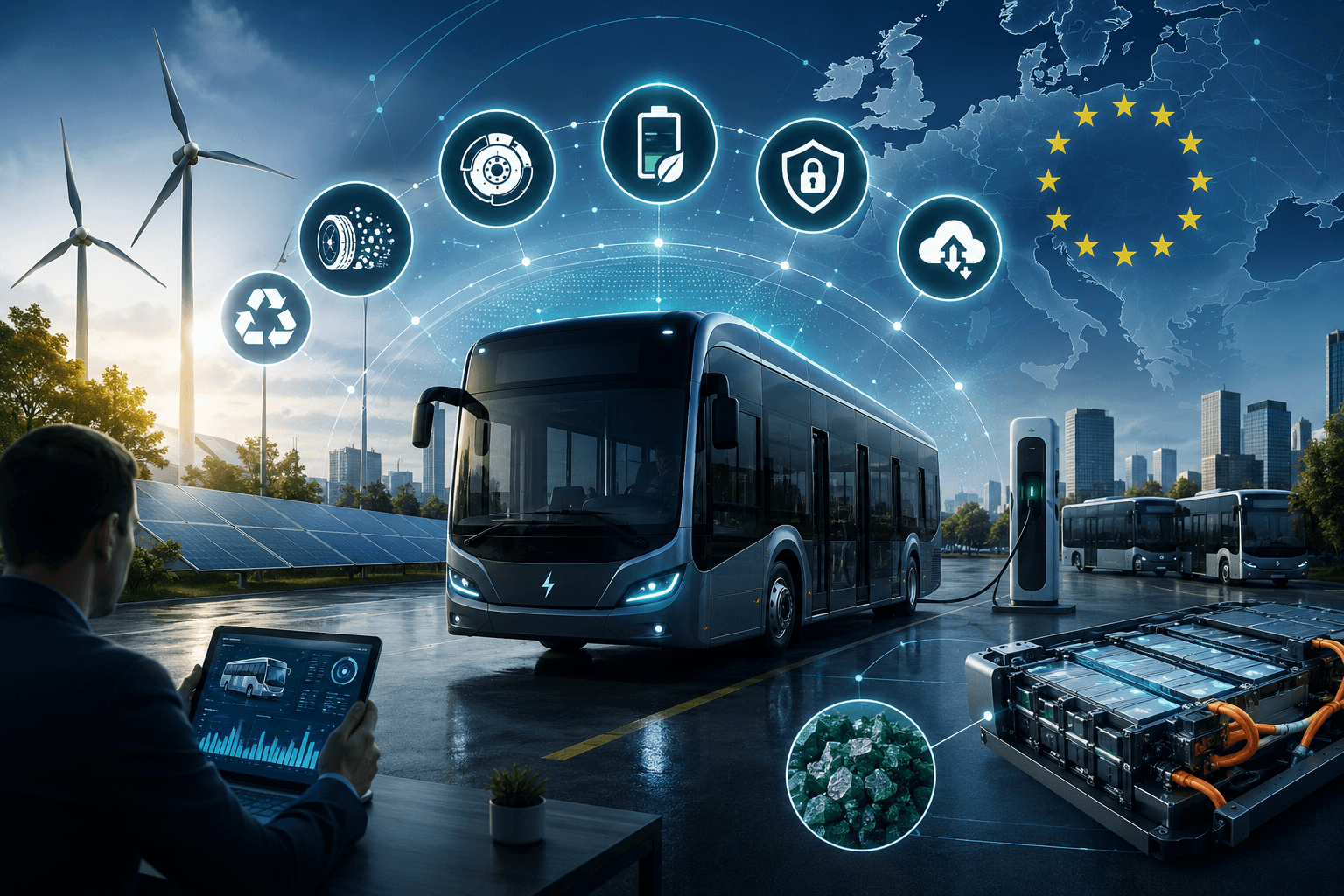

I come to Busworld every two years. With each edition, vehicles become a little more modern, screens get larger, batteries become more powerful, and designs grow increasingly ambitious. Yet this year, what caught my attention was not the vehicles themselves, but rather the topics being discussed across the industry.
Just a few years ago, the most common question in meeting rooms was: “When will electrification accelerate?” Today, those same people are asking a different question: “How much time do we have left to adapt?”
This shift is no coincidence. In recent years, the European Union has launched the most comprehensive transformation process the transport sector has ever faced. Moreover, this transformation extends far beyond propulsion technologies and energy sources. From vehicle manufacturing and operation to batteries, software infrastructure, supply chains, and data management, the entire ecosystem is being reshaped.
For a long time, the industry viewed electric vehicles as the ultimate objective. Today, however, being electric is merely the starting point. The real differentiator will be whether vehicles can comply with Europe’s increasingly complex regulatory framework throughout their entire lifecycle.
The Euro 7 Regulation is perhaps the best example of this new reality. Many people still view Euro 7 simply as a stricter emissions standard. In reality, it introduces a far more comprehensive approach. Issues such as particulate emissions generated by brake wear, microplastics released from tires, the long-term durability of battery performance, and the remote monitoring of vehicle data are now being addressed within a single regulatory framework.
This highlights an important reality: in the future, manufacturing a zero-emission vehicle alone will not be sufficient. Manufacturers will also need to demonstrate environmental performance and technical compliance throughout the vehicle’s operational life. In other words, type approval is no longer the end of the process—it is becoming the beginning.
At the same time, Europe’s heavy-duty vehicle decarbonization targets are directly influencing manufacturers’ strategies. As 2030 approaches, the share of zero-emission vehicles in urban public transport will increase rapidly. Beyond 2035, newly produced diesel city buses are expected to play only a limited role in the European market. Consequently, the investment decisions manufacturers make today will determine not only next year’s sales but also their access to the market over the coming decade.
Yet perhaps the most significant issue of the next phase will not be technology itself, but traceability.
Through the EU Battery Regulation, the European Union has introduced the concept of the “battery passport,” a development that is set to fundamentally change the way manufacturers and suppliers operate. Information such as the origin of raw materials, carbon footprint, recycled content, and the battery’s lifecycle history will become digitally traceable. As a result, manufacturers will need to develop capabilities not only in engineering but also in data management and sustainability.
Similarly, vehicle-generated data and cybersecurity are becoming increasingly important. In a world where software updates are delivered remotely, vehicles continuously generate data, and fleets are managed in real time, software security is no longer merely a technical consideration—it is a business necessity. In the years ahead, the most successful bus manufacturers will not simply be those that build excellent vehicles, but those that possess robust data governance and cybersecurity infrastructures.
In addition, the industry faces another critical challenge: the shortage of drivers. Across Europe, tens of thousands of driver positions remain unfilled, and the gap continues to widen in many countries. Consequently, autonomous driving technologies are no longer viewed solely as research and development projects. They are increasingly becoming part of operators’ strategies for operational sustainability. Recent pilot projects and real-world deployments suggest that autonomous systems may be integrated into everyday transport operations faster than many anticipated.
Türkiye is not outside this transformation. On the contrary, as one of Europe’s most important manufacturing hubs, it is positioned at the very center of it. TEMSA, Otokar, Karsan, Anadolu Isuzu, Bozankaya, and other manufacturers have achieved remarkable success in electric mobility over recent years.
However, the key question for the future is no longer whether vehicles are electric. The real question is whether the entire supply chain is prepared for Europe’s new regulatory environment.
In the future, competitive advantage in the European market will not be determined solely by product quality. Everything from braking systems and battery management software to data communication infrastructure and cybersecurity solutions will need to evolve. For second- and third-tier suppliers unable to adapt, the risks may be even greater than those faced by vehicle manufacturers themselves.
When we look at the vehicles displayed at Busworld 2026, we are not actually looking at the future—we are looking at the transition toward it.
Today, the central question facing the industry is no longer whether a bus is electric. The real questions are whether its battery is traceable, whether its data is securely managed, and whether it can remain compliant with European regulations throughout its entire lifecycle.
Over the next five years, success in the European market will not be determined by technology alone. The companies that thrive will be those capable of managing technology, regulation, and sustainability simultaneously.
And today, the industry's greatest competitor is not China, Europe, or even a new technology.
It is time.
European Parliament and Council Regulation (EU) 2024/1257 (Euro 7 Emission Standards)
Regulation (EU) 2019/1242 on CO₂ Emission Performance Standards for Heavy-Duty Vehicles and Related Revisions
Directive (EU) 2019/1161 (Clean Vehicles Directive)
Regulation (EU) 2023/1542 Concerning Batteries and Waste Batteries
International Road Transport Union (IRU) Driver Shortage Reports 2024–2025
International Council on Clean Transportation (ICCT) Heavy-Duty Vehicle Market and Emissions Studies
European Commission Sustainable and Smart Mobility Strategy
UNECE Regulations R155 (Cybersecurity) and R156 (Software Updates)
Sustainable Bus Market Reports and Industry Analysis 2024–2026