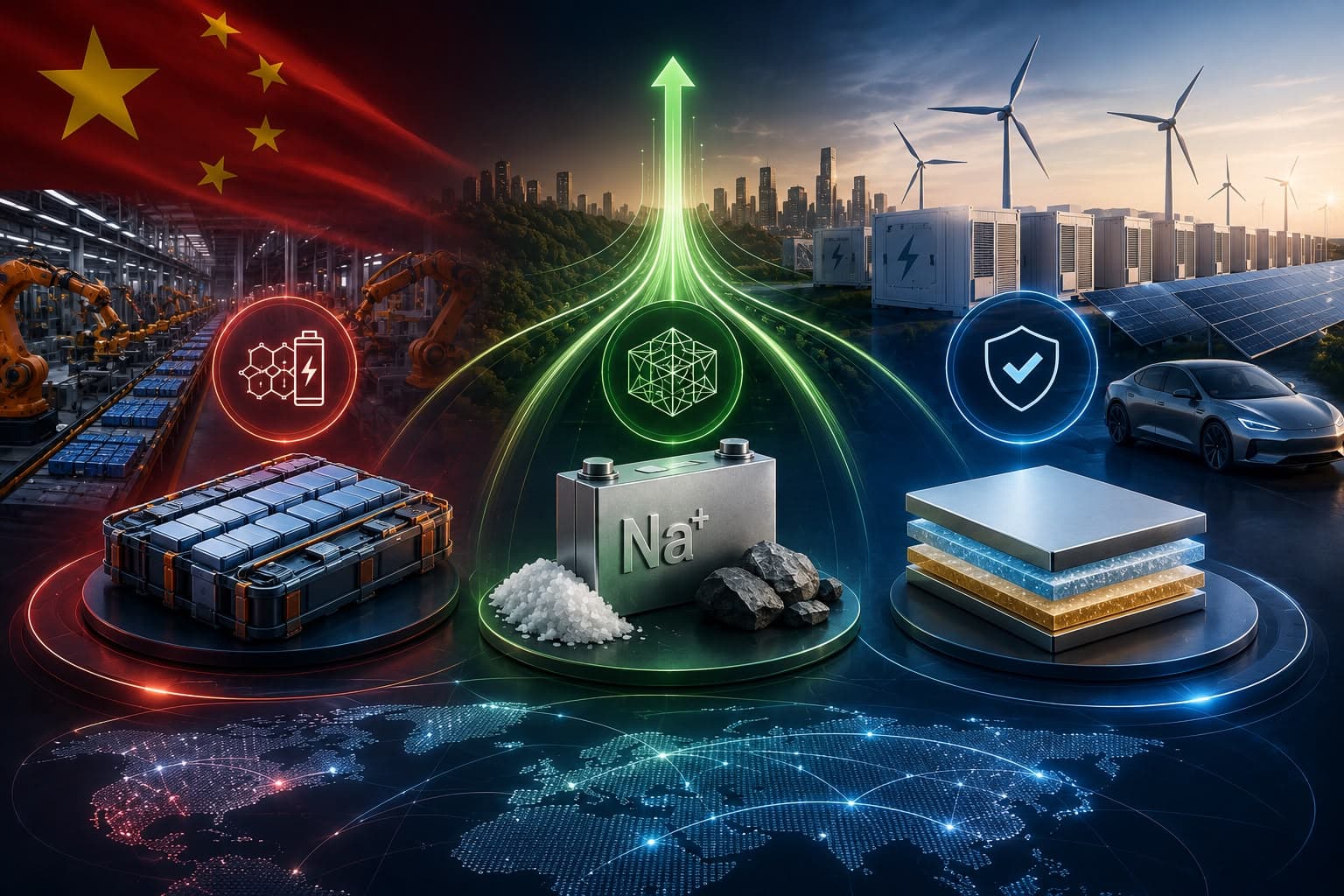

The reinstatement of China's consumption tax on lithium-ion batteries has become one of the most discussed developments in the battery industry in recent days. At first glance, the decision may appear to be nothing more than an ordinary tax measure that will increase manufacturers' costs. In reality, however, it reflects a much broader industrial policy strategy.
Under the new regulation, lithium-ion batteries, which had previously been exempt from the consumption tax, will be subject to a 2% consumption tax from September 1, 2026, increasing to 4% from September 1, 2027. By contrast, sodium-ion batteries, solid-state batteries, and fuel cells will remain exempt from the consumption tax until December 31, 2028, provided that they comply with the relevant national technical standards. Accordingly, rather than introducing an entirely new tax, China is gradually withdrawing the tax incentives that have long been available to certain battery technologies.
In my view, the real significance of this decision lies not in the tax rates themselves, but in how China is positioning different battery technologies. The regulation establishes a clear technological hierarchy. Lithium-ion batteries are now regarded as a sufficiently mature technology capable of competing without preferential tax treatment. Meanwhile, sodium-ion and solid-state batteries are being positioned as strategic technologies that are expected to drive the next phase of industry growth.
The timing of this policy is also noteworthy. China is currently the world's largest battery producer by a significant margin. However, particularly in the standard LFP (lithium iron phosphate) battery segment, excessive manufacturing capacity, intense price competition, and shrinking profit margins have become defining characteristics of the industry. While production volumes continue to increase, value creation has not kept pace—one of the structural challenges China has been seeking to address in recent years. In such an environment, tax policy ceases to function merely as a fiscal instrument for generating government revenue; instead, it becomes a strategic mechanism for directing investment, production capacity, and research and development priorities.
For this reason, it would be misleading to interpret the regulation as evidence that China is abandoning lithium-ion technology. On the contrary, China seeks to preserve its current leadership while simultaneously securing a dominant position in the next technological cycle. In other words, it is not penalizing today's successful technology; rather, it is accelerating the development of the technologies expected to deliver tomorrow's competitive advantage.
Sodium-ion batteries are attracting growing attention because of their potential to reduce dependence on lithium and graphite, their promising low-temperature performance in certain applications, and their economic advantages, particularly in grid-scale energy storage systems. Nevertheless, based on the current state of technological development, their energy density remains below that of advanced LFP and NMC (nickel manganese cobalt) batteries. Consequently, sodium-ion batteries are not expected to replace lithium-ion batteries entirely in long-range electric vehicles in the near future.
Solid-state batteries present a different story. Their higher energy density, faster charging potential, and enhanced safety characteristics make them one of the industry's most promising long-term technologies. However, challenges related to mass-production costs, manufacturing complexity, and scalability have yet to be fully overcome. Even so, China's decision to extend tax incentives to this technology demonstrates that its industrial policy is designed not only around today's commercial realities but also around the competitive landscape of the coming decade.
Accordingly, the future of the battery industry should not be viewed as a competition in which one technology completely replaces all others. Rather, it is more appropriate to envision a multi-layered technological ecosystem in which different battery chemistries specialize in different applications. LFP batteries are likely to retain their strong position in the mass-market electric vehicle segment due to their cost-effectiveness, reliability, and manufacturing scale. NMC batteries are expected to remain important for premium vehicles requiring higher energy density. Sodium-ion batteries may experience faster growth in energy storage systems, short-range electric vehicles, and other cost-sensitive applications. As solid-state batteries reach greater technological maturity, they have the potential to establish new standards in premium electric vehicles, aerospace, and other high-performance applications.
From Türkiye's perspective, this development should not be regarded merely as a measure affecting the cost of batteries imported from China. It represents a significant policy shift that could indirectly influence investment decisions across a broad spectrum of sectors, including electric vehicle manufacturing, energy storage projects, the domestic battery ecosystem, and strategies concerning critical minerals.
I therefore do not view this regulation simply as the introduction of a new tax on batteries. Rather, I believe China is using tax policy as a strategic instrument to shape the next phase of innovation in the global battery industry. In the years ahead, competition will not be determined solely by manufacturing capacity, but also by which technologies attract investment, which can be commercialized and scaled most rapidly, and which ultimately deliver the lowest total cost of ownership. For that reason, the long-term impact of this policy is likely to extend far beyond the relatively modest tax rates themselves.