
The Intergovernmental Panel on Climate Change (IPCC), established in 1988 by the World Meteorological Organization (WMO) and the United Nations Environment Programme (UNEP), was created to assess scientific, technical, and socio-economic information related to climate change and to provide guidance to policymakers on combating its impacts. Türkiye is also a member of the IPCC.
The IPCC’s 2018 Special Report on Global Warming of 1.5°C emphasized the importance of achieving net-zero carbon dioxide emissions by mid-century—or earlier—in order to avoid the worst impacts of climate change. Currently, the Earth is approximately 1.2°C warmer than in the late 1800s. As set out in the Paris Agreement, global warming should be limited to 1.5°C, which requires reducing global emissions by 45% by 2030 and reaching net-zero by 2050.
Considering that approximately 2.5% of global carbon emissions originate from aviation activities, improvements within the aviation sector are clearly of great importance.
So, what is being done to reduce carbon emissions in international civil aviation?
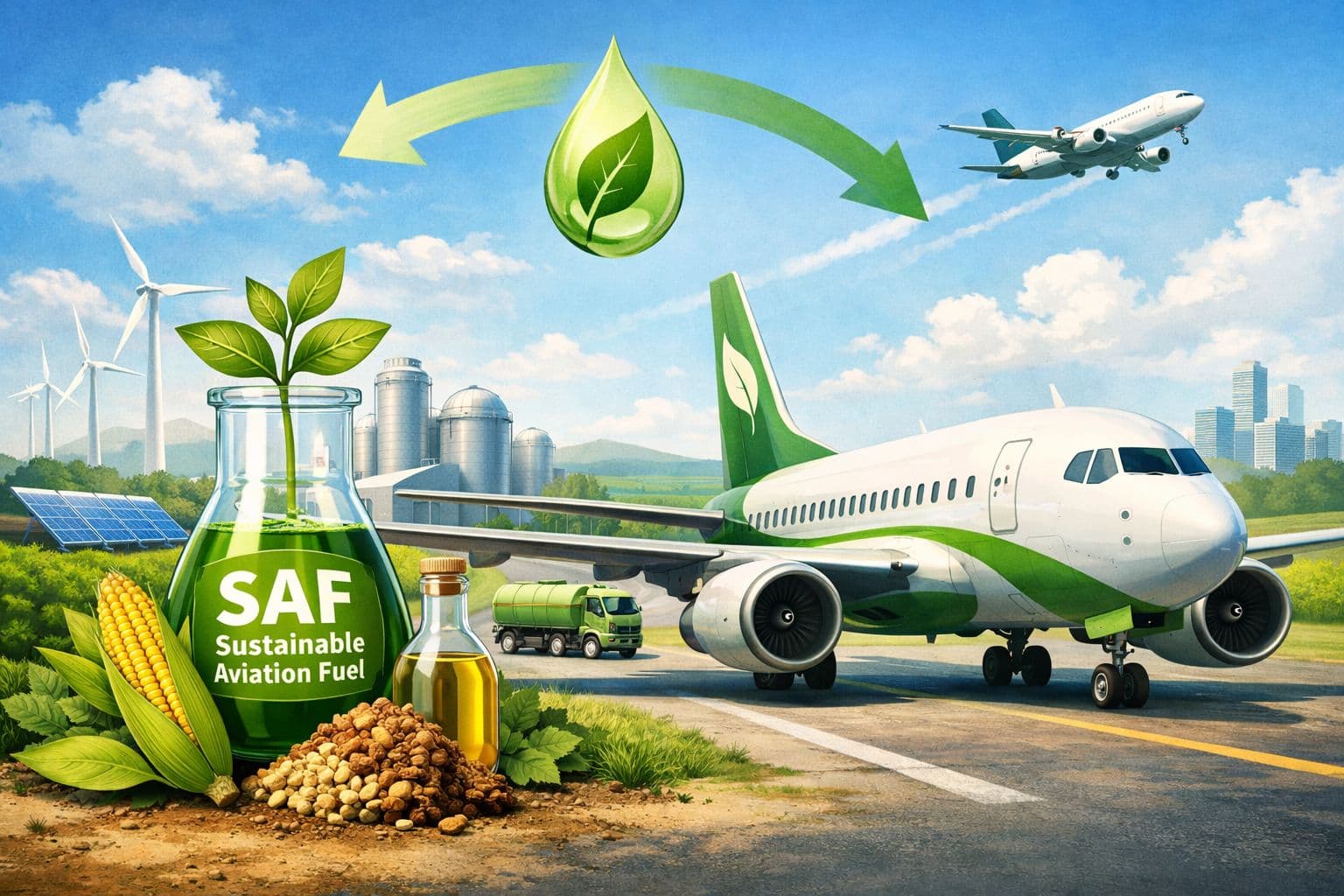
At the 41st International Civil Aviation Organization (ICAO) Assembly, a long-term global aspirational goal was adopted to achieve net-zero carbon emissions from international aviation by 2050. Achieving this target depends largely on Sustainable Aviation Fuels (SAF), innovative propulsion technologies, and other efficiency improvements, including advancements in air traffic management and navigation systems.
Since the main focus of this article is aviation fuels, it is worth highlighting the relevant developments. ICAO organized the first Conference on Aviation and Alternative Fuels in Brazil on 16–18 November 2009. As a result of this conference, the ICAO Global Framework for Aviation Alternative Fuels (CAAF) was established. At the third Conference on Aviation and Alternative Fuels, held on 20–24 November 2023, the “ICAO Global Framework for Sustainable Aviation Fuels (SAF), Lower Carbon Aviation Fuels (LCAF), and Other Cleaner Aviation Energies” was adopted. This framework aims to promote the global use of SAF, LCAF, and other clean aviation energy sources.
To achieve this objective, various stakeholders in the aviation sector have important responsibilities:
a. Aircraft Operators:
They are expected to prioritize negotiations, cooperation, and commercial procurement processes related to SAF, LCAF, and other clean aviation energy sources. They should also establish mechanisms to facilitate voluntary access for passengers, air cargo shippers, and businesses wishing to reduce their carbon footprint by purchasing SAF, LCAF, and other clean fuels. Additionally, they must implement measures to enhance SAF compatibility within their fleets.
b. Airports:
They are responsible for planning and implementing the necessary airport infrastructure modifications to ensure efficient supply and access to “drop-in” fuels. They should also collaborate with aircraft operators, fuel producers, and other stakeholders to explore innovative financing and cost-sharing models across the value chain.
c. Aircraft and Engine Manufacturers, and Fuel Producers:
They are expected to accelerate efforts—once deemed safe and in line with their commitments—to enable 100% SAF compatibility in newly produced, currently manufactured, and existing aircraft. In the long term, they should also innovate to better understand and maximize opportunities offered by other cleaner energy sources.
d. Fuel Producers:
In line with ICAO’s Carbon Offsetting and Reduction Scheme for International Aviation (CORSIA) requirements, they are encouraged to promote innovation and investment into SAF, LCAF, and other clean aviation energies, and to demonstrate their technological readiness, scalability, and sustainability.
e. ICAO-Approved Sustainability Certification Schemes:
These programs are expected to accelerate the sustainability certification processes for eligible SAF, LCAF, and other clean aviation energy sources in accordance with CORSIA requirements.
f. Fuel Standardization Bodies:
Fuel standards bodies, particularly ASTM to work with all stakeholders to accelerate the qualification and approval of additional fuel production pathways.
The same framework document also emphasizes that States also should undertake efforts to support the development and deployment of SAF, LCAF, and other clean aviation energy sources.
In Turkish civil aviation legislation, important regulatory steps have also been taken to align with sustainable aviation fuels. We will address this issue in more detail in our forthcoming articles.
With my kind regards and best wishes to all.
References
IPCC Türkiye Raporu. (Access Date: 20.02.2026). https://www.tarimorman.gov.tr/ABDGM/Belgeler/Uluslararas%C4%B1%20Kurulu%C5%9Flar/IPCC%20TR.pdf
International Energy Agency (IEA). (2021, October). Net Zero by 2050 – A Roadmap for the Global Energy Sector, p. 32. (Access Date: 20.02.2026). https://www.iea.org/reports/net-zero-by-2050
United Nations. (Access Date: 20.02.2026). Climate Action. https://www.un.org/en/climatechange/net-zero-coalition?ysclid=ml233oefip355721791
International Civil Aviation Organization (ICAO). (Access Date: 20.02.2026). Long Term Global Aspirational Goal (LTAG) for International Aviation. https://www.icao.int/environmental-protection/long-term-global-aspirational-goal-ltag-international-aviation
International Air Transport Association (IATA). (2025, December). Net Zero 2050: Sustainable Aviation Fuels (SAF). (Access Date: 20.02.2026). https://www.iata.org/en/iata-repository/pressroom/fact-sheets/fact-sheet-sustainable-aviation-fuels/
International Civil Aviation Organization (ICAO). (Access Date: 16.02.2026). Civil Aviation Alternative Fuels (CAAF) Conferences. https://www2023.icao.int/meetings/caaf2009/Pages/default.aspx
International Civil Aviation Organization (ICAO). (2023, November). ICAO Global Framework on Aviation Cleaner Energies. (Access Date: 20.02.2026). https://www.icao.int/sites/default/files/environmental-protection/Documents/ICAO-Global-Framework-on-Aviation-Cleaner-Energies_24Nov2023-1.pdf