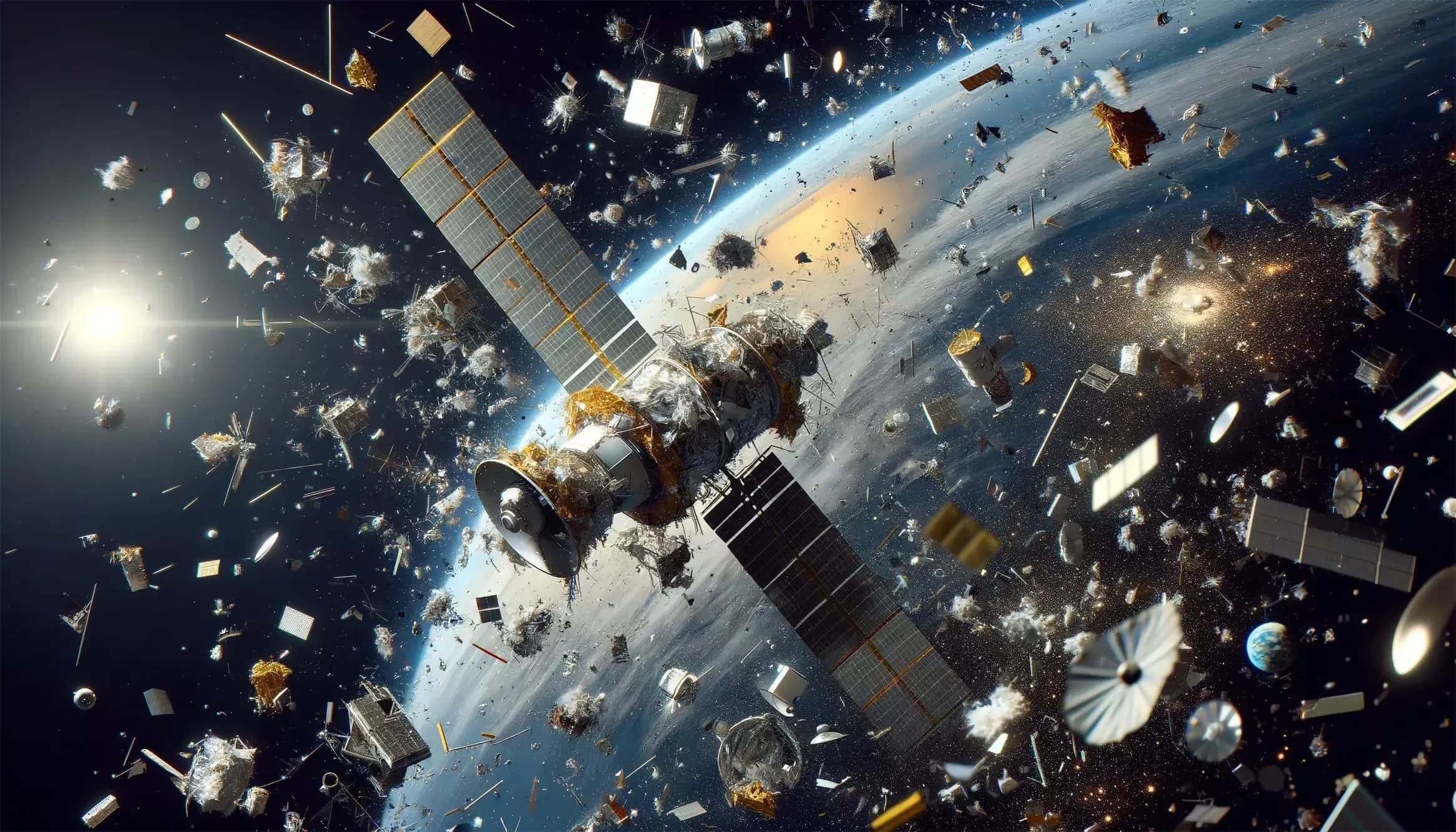

A few days ago, with the eighth launch of a set of 60 satellites, the total number of satellites launched under the project, including the two prototypes sent in February 2018, reached 482. This exciting project, of course, also has aspects that cause concern. Perhaps the most important of these is the potential for space debris. So, what is space debris and what kind of regulations are there regarding this issue?
The problem of space debris began with the launch of the first artificial satellite, Sputnik 1, on October 4, 1957. In the 1960s, the possibility of a debris problem in space began to be voiced in circles working on space activities, and the first conference on orbital debris was held by NASA in 1982. Later, the European Space Agency (ESA) also organized a workshop in September 1985 concerning the re-entry of space debris, due to the failures of the Skylab and Cosmos 1402 satellites. A year later, in 1986, it established a working group. While these developments were taking place in Europe, in the U.S. in 1987, the DoD (Department of Defense) stated for the first time in its official space policy that it would seek to minimize space debris in military operations. According to some sources, NASA and ESA have provided regular coordination since 1987. ESA’s working group also published a report in 1988, and a decision was taken by the ESA Council in 1989. The Agency set its debris goals as follows:
Minimization of space debris generation
Reduction of risk for human spaceflight
Reduction of risks on the Earth’s surface from the re-entry of spacecraft
Reduction of risk for Geostationary Satellites
In the same year, a report on orbital debris was also prepared in America. Following this report, NASA began measuring orbital debris with radar and modeled it with computer simulations. Consultations were also held with space agencies regarding space debris, and subsequently, the Inter-Agency Space Debris Coordination Committee (IADC) was established in 1993. IADC, whose members include ASI, JAXA, CNES, KARI, CNSA, NASA, CSA, ROSCOSMOS, DLR, SSAU, ESA, the UK Space Agency, and ISRO, continues its work on space debris today. The Committee defined space debris as: “All man-made objects, including pieces and other elements, located in Earth orbit or entering the atmosphere that have lost their function.” Also in 1993, ESA held the first European Conference on space debris, which was attended by the leading countries in space activities.
When we came to 1994, the Scientific and Technical Subcommittee of the United Nations Committee on the Peaceful Uses of Outer Space (UNCOPUOS) decided to prioritize the agenda item on space debris for the first time at its 31st session. A year later, UNCOPUOS decided to focus on issues such as the measurement and mathematical modeling of space debris, the disposal of space debris risks, and the design of spacecraft to be protected against space debris. In the same year, NASA also issued a guideline for reducing the first orbital debris. Pursuant to NASA’s Procedures and Guidelines for Assessing and Limiting Orbital Debris, prepared in 1995, the following matters were regulated: depletion of on-board energy sources following the completion of the mission, limiting the orbital lifetime after mission completion to 25 years or sending it to a graveyard orbit, ensuring that debris generation is a natural consequence of normal space operations, minimization of the results of interactions with existing orbital debris or meteoroids, and minimization of the risk posed by re-entering space system components to Earth after the mission.
Following NASA’s regulation, other space agencies also made similar regulations. The National Space Development Agency of Japan, NASDA (NASDA, the Japan Space Development Agency, established on October 1, 1969, operated until October 1, 2003. Subsequently, ISAS (Institute of Space and Astronautical Science), NAL (National Aerospace Laboratory of Japan), and NASDA merged to form the Japan Aerospace Exploration Agency (JAXA)), adopted a series of regulations in 1996 to reduce space debris, including but not limited to: prevention of breakups occurring in orbit after the completion of the mission in space systems causing large amounts of debris, sending the spacecraft completing its life in GEO to a higher orbit to protect GEO, minimizing the objects released during the operational phase of the space system, and limiting the time spent in orbit after the mission.
When we came to March 1999, this time the French National Centre for Space Studies (CNES DG) made some new regulations as safety requirements. Accordingly, additional obligations have been imposed regarding space activities. These were regulated in three separate categories: managerial obligations (having one debris manager for each program), design obligations (designing in a way that minimizes debris generation, etc.), and operational obligations (25-year lifetime limit, passivation, etc.).
Immediately afterward, in April 1999, ESA prepared the “Space Debris Mitigation Handbook.” In addition to the regulations made in the domestic laws of the leading countries in space activities, as I mentioned just now, the IADC, of which space agencies are members, also accepted three fundamental principles by consensus in 2003. Accordingly, breakups that may occur in orbit will be avoided, spacecraft and fragments will be removed from heavily used orbital regions after completing their missions, and the release of fragments will be limited during normal operations.
When it came to October 2002, the IADC unanimously adopted the “IADC Space Debris Mitigation Guidelines.” The guidelines were also submitted to the Scientific and Technical Subcommittee of UNCOPUOS in February 2003. The guidelines, which underwent some minor changes in 2007, compiled the current practices for limiting space debris. Although the guidelines, which focus particularly on reducing debris generated during normal operations, minimizing the possibilities of in-orbit breakups, post-mission disposal, and preventing in-orbit collisions, are not a binding regulation, they are an important work and served as a reference for the United Nations guidelines and ISO Standard 24113 “space systems – space debris mitigation.”
In 2007, pursuant to the agenda item on space debris of the Scientific and Technical Subcommittee of UNCOPUOS, Argentina, Australia, Canada, China, the Czech Republic, France, Germany, India, Italy, Japan, Malaysia, the Republic of Korea, the Russian Federation, South Africa, Ukraine, and the U.S. shared their views and proposals on this issue. The U.S., Russia, and France made presentations regarding their own practices for reducing space debris. Russia also made a presentation on the research results regarding the artificial satellite population in the GEO region and its proposals for establishing an international cooperation organization regarding the observation of space debris in GEO.
The “United Nations Committee on the Peaceful Uses of Outer Space Space Debris Mitigation Guidelines,” prepared as a result of the work carried out by the Scientific and Technical Subcommittee of UNCOPUOS since the early 1990s, was adopted in 2007. With the resolution of the United Nations General Assembly dated December 22, 2007, and numbered 62/217, countries were encouraged to comply with these in their national regulations.
The following are regulated in the guidelines in general terms:
Limitation of debris released during normal operations: Space systems should be designed to leave minimal debris during their normal operations.
Minimization of the probability of in-orbit breakup and fragmentation during operation, and planning of destruction and passivation measures in case of breakup, if this is not possible.
Limitation of the probability of accidental in-orbit collision: The design of spacecraft and launch vehicles should calculate and limit the probability of collision with known objects during launch and while in orbit.
Avoidance of intentional destruction or other harmful activities: If the destruction of any spacecraft in orbit will cause new debris formation in the long term, this should be avoided.
Minimization of post-mission breakups resulting from stored energy: Spacecraft that have exceeded their useful life must be passivated, which requires the venting of all stored energy.
Limitation of the long-term presence of spacecraft and launch vehicle orbital stages in the LEO region after mission completion: During the clearance of objects from LEO, necessary care should be taken to ensure that the risk of these debris reaching Earth does not cause harm to persons or property, including environmental pollution resulting from toxic waste.
Limitation of the long-term effect of spacecraft and launch vehicles in GEO after mission completion: The risk of collision of space objects near the GEO region can be reduced by sending the objects to an orbit above GEO after they complete their missions. This prevents them from interacting with the GEO region or returning to GEO.
In addition to IADC and UNOOSA, there are other institutions and organizations dealing with space debris. The International Organization for Standardization (ISO), established in 1946 to determine standards other than electrical and electronic engineering issues falling within the scope of the International Electrotechnical Commission, and of which Turkey became a member in 1955, has also created technical reports and standards for the reduction of space debris.
These are:
ISO 24113, Space systems – Space debris mitigation requirements. (Publication date: 1st Edition 2010, 2nd Edition 2011, 3rd Edition in preparation)
It includes requirements that can be applied to all elements of uncrewed systems. It is regulated for the purpose of ensuring that the spacecraft and launch vehicle do not generate debris during their orbital lifetime, thereby reducing space debris. It is the most fundamental ISO standard regarding space debris.
ISO 23312, Space systems – Detailed space debris mitigation requirements for spacecraft. (Publication date: 1st Edition – in preparation)
It is intended to support compliance with the spacecraft-related parts of ISO 24113. Comprehensive regulations regarding spacecraft will be made.
ISO 20893, Space systems – Detailed space debris mitigation requirements for launch vehicle orbital stages.
ISO 11227, Space systems – Test procedures for the assessment of hypervelocity impact ejecta from spacecraft materials (Publication date: 1st Edition: 2012, 1st Amendment – in preparation). The data that can be obtained will be important in the decision stage, especially for selecting suitable materials for the outer surface of the spacecraft.
ISO 14200, Space environment (natural and artificial) – Guideline for process-based implementation of meteoroid and space debris environmental models (orbit altitude less than GEO + 2000 km) (Publication date: 1st Edition – 2012)
ISO 16126, Space systems – Assessment of survivability to space debris and meteoroid impact for successful post-mission disposal of uncrewed spacecraft (Publication date: 1st Edition 2014)
ISO 27852, Space systems – Orbital lifetime estimation. (Publication date: 1st Edition – 2011; 2nd Edition – 2016). The standards here also support compliance with the ISO 24113 articles regarding post-mission disposal in the LEO region.
ISO 27875, Space systems – Re-entry risk management for uncrewed spacecraft and launch vehicle orbital stages (Publication date: 1st Edition – 2010; Amendment 1- 2016; 2nd Edition – in preparation.)
ISO / TR 16158, Space systems – Collision avoidance for orbiting objects: Best practices, data requirements and operational concepts. (Publication date: 1st Edition – 2013; 2nd Edition – in preparation)
ISO /TR 18146, Space systems – Guide to space debris mitigation design and operation for spacecraft. (Publication date: 1st Edition 2015)
ISO / TR 20590, Space systems – Guide to space debris mitigation design and operation for launch vehicle orbital stages. (Publication date: 1st Edition 2017)
ISO 13541, Space data and information transfer systems – Conjunction data message. (Publication date: 1st Edition – 2010; 2nd Edition – in preparation)
ISO 26900, Space data and information transfer systems – Orbital data messages. (Publication date: 1st Edition 2012; 2nd Edition – in preparation) These data exchanges are important for issues such as collision avoidance and space traffic management.
ISO 13526, Space data and information transfer systems – Tracking data message. (Publication date: 1st Edition – 2010; 2nd Edition – in preparation)
ISO 19389, Space data and information transfer systems – Conjunction data message. These data exchanges provide critical information to satellite owners/operators for timely collision avoidance.
As you can see, ISO standards are quite comprehensively organized. Another international regulation regarding the prevention and reduction of space debris has been made by the International Telecommunication Union (ITU).
Briefly about the ITU; the union, which was first established as the “International Telegraph Union” in 1865 by 20 founding members including the Ottoman Empire, then became an organization operating under the United Nations on October 15, 1947.
The Union has three sectors. These are the Radiocommunication Sector (ITU–R), the Telecommunication Standardization Sector (ITU-T), and the Telecommunication Development Sector (ITU-D).
The Radiocommunication Sector, which operates for the fair, efficient, rational, and economical use of the radio frequency spectrum and satellite orbits for all telecommunication services, adopted a recommendation resolution on “Environmental Protection of the Geostationary-Satellite Orbit” in 1993. The recommendations were amended in 2004 and reached their final form in 2010.
Pursuant to the ITU-R S.1003-2 (12/2010) recommendation, approved on December 17, 2010;
Recommendation 1: When placing a satellite into orbit, as little debris as possible will be released into the GSO region.
Recommendation 2: Every reasonable effort shall be made to reduce the lifetime of debris in elliptical transfer orbits whose apogee is at or near the GSO altitude.
Recommendation 3: The GEO satellite should be moved out of the GSO region before its fuel is completely depleted at the end of its life, such that under the influence of natural disturbing forces in its orbit, its perigee will remain in an orbit not less than 200 km below the GEO altitude.
Recommendation 4: Transfer to a graveyard orbit will be carried out with special care to avoid radio frequency interference with active satellites.
This recommendation, ITU-R 2.1003.2, which is still in force, is applicable to member states of the International Telecommunication Union and concerns the operations of satellites in GSO, but it is not legally binding due to it being a recommendation of the ITU Radiocommunication Assembly.
Finally, since it is an international organization, and since I have addressed international regulations regarding space debris, I would like to mention the regulation of the European Space Agency (ESA), which I found beneficial to mention. The administrative instructions and policies of the ESA Director General are binding for all ESA employees, and compliance with them must be ensured in ESA’s relations with third parties. ESA has also made a regulation by referring to the European Code of Conduct for Space Debris Mitigation, the IADC, and the U.N.’s guidelines on space debris mitigation. The administrative instruction of the European Space Agency Director General, “Policy for Space Debris Mitigation in Agency Projects,” entered into force on March 28, 2014. This regulation supersedes ESA’s previous instruction from 2008.
With the said instruction, the ECSS-U-AS-10C standard, created by the European Cooperation for Space Standardization (ECSS) in 2012, was accepted as the ESA standard for technical requirements regarding space debris mitigation for Agency projects.
It can be said that the leading countries in space activities also have laws in their domestic legislation aimed at reducing space debris.