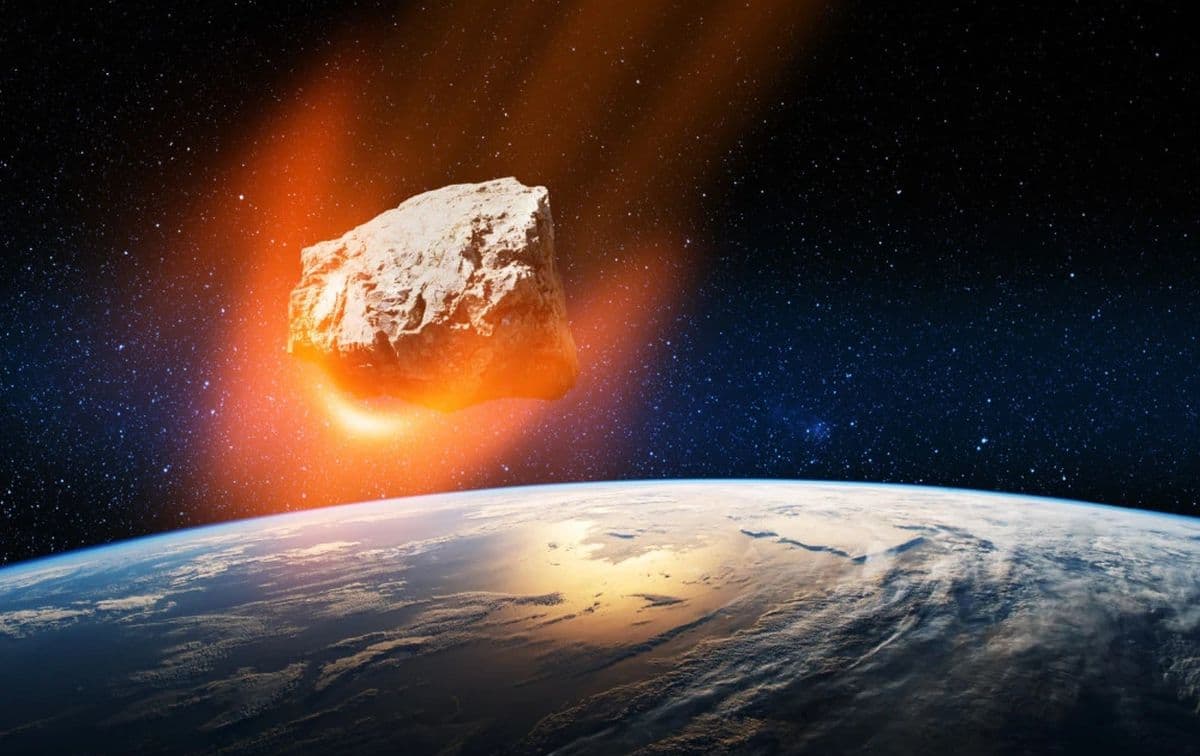

Asteroids with many reserves, including but not limited to gold, silver, platinum, and titanium, also pose a risk to us in some respects. For this reason, in today’s article, I wanted to address the studies related to potentially hazardous asteroids.
There are millions of asteroids in our Solar System. According to data from the European Space Agency, approximately 10,000 of these are NEOs (Near-Earth Objects). If an asteroid or a fragment of it strikes the Earth, it is called a meteorite. Even rarely, meteorites have the potential to cause serious dangers. Let’s not forget that; according to some scientists, the reason for the extinction of 93% of mammal species on Earth, including dinosaurs, and many other animal and plant species 66 million years ago, was a 10 km wide meteorite that struck the Yucatan Peninsula in Mexico. Damage has occurred similarly in more recent history as a result of meteorite impacts. For example, a forest area in Siberia was damaged in 1908 due to a meteorite that fell near the Tunguska River. Not long ago, on February 15, 2013, a celestial body estimated to be 17-20 meters in diameter exploded at 66,000 km per hour over Chelyabinsk (Russia), causing injuries to many people and damage to buildings.
Today, the tracking of celestial bodies is carried out to a certain extent with technological means. For example, NASA has had an NEO observation program since 1998. Nevertheless, international cooperation is very important to avoid any unpleasant surprises or to eliminate such a possibility if it exists. This is why, on the recommendation of “Action Team 14,” a technical forum established under the instruction of the United Nations Committee on the Peaceful Uses of Outer Space (UNCOPUOS), the IAWN (International Asteroid Warning Network) and SMPAG (Space Mission Planning Advisory Group) were established in 2014, supported by the United Nations General Assembly resolution A/RES/68/75 dated December 11, 2013, for the purpose of international cooperation against the threat of NEO impact.
IAWN, which continues its activities on a voluntary basis, includes institutions such as ESA, NASA, INASAN (Institute of Astronomy of the Russian Academy of Sciences), KASI (Korea Astronomy and Space Science Institute), as well as observers. Today, IAWN has members from Europe, Asia, North and South America. IAWN is a network of institutes that carry out discovery, observation, and other studies related to the potentially harmful NEO population. The said Network works to establish notification thresholds and criteria regarding the emerging impact hazard and to inform states so that they can prepare for the expected impact consequences. All information from IAWN, which serves the purpose of providing up-to-date and accurate data on NEO and NEO impact risks, can be obtained free of charge by interested parties.
Similarly, SMPAG was also established, encouraged by the U.N. resolution A/RES/68/75 dated December 11, 2013, for the purpose of an international solution against the threat of NEO impact. Membership in SMPAG, which was established with the aim of engaging in activities such as creating a timeline and main framework for the deflection and redirection of NEOs, initiating and maintaining the relevant space mission, and developing international cooperation for research to be carried out for the same purpose, is open to all national space agencies or government agencies or intergovernmental organizations that coordinate or finance space activities and have the capacity to pursue or contribute to space-based NEO risk mitigation activities.
UNOOSA, ASE (Association of Space Explorers), IAA (The International Academy of Astronautics), and IAU (The International Astronomical Union) are also in observer status in SMPAG, which has many members such as DLR, ROSCOSMOS, KASI, and NASA.
Pursuant to the U.N. General Assembly resolution no. 71/90 dated December 2016, it was also decided that the United Nations Office for Outer Space Affairs shall be the permanent secretariat of SMPAG. According to the decision of the Scientific and Technical Subcommittee of UNCOPUOS dated February 22, 2016, IAWN and SMPAG will prepare and submit annual reports and will be invited as observers to the subcommittee sessions.
The ad hoc working group established by SMPAG, which held its 10th meeting on January 31, 2018, regarding legal issues, has also been tasked with evaluating what SMPAG can and cannot do under existing treaties and agreements related to space law.
The warning criteria recommendations in the IAWN and SMPAG status report of the UNCOPUOS Scientific and Technical Subcommittee dated February 2, 2017, include the following:
IAWN will issue warnings about expected impacts for all objects larger than 10 meters, or with an absolute magnitude of approximately 28 if brightness data can be obtained, and with an impact probability greater than 1%.
Preparedness planning on Earth is recommended to be carried out if the following possible impact warnings occur:
Expected to occur within 20 years,
Impact probability is greater than 10%, and
If the object is larger than 20 meters, or its absolute magnitude is approximately 27 if brightness data can be obtained.
SMPAG will plan mission options when warned about the following impact probabilities:
Expected to occur within 50 years
Probability is greater than 1%, and
If the object is larger than 50 meters, or its absolute magnitude is approximately 26 if brightness data can be obtained.
I believe it is beneficial to follow the work of these formations, which will hold their next meetings on October 21-26, 2018.